
 Posted by
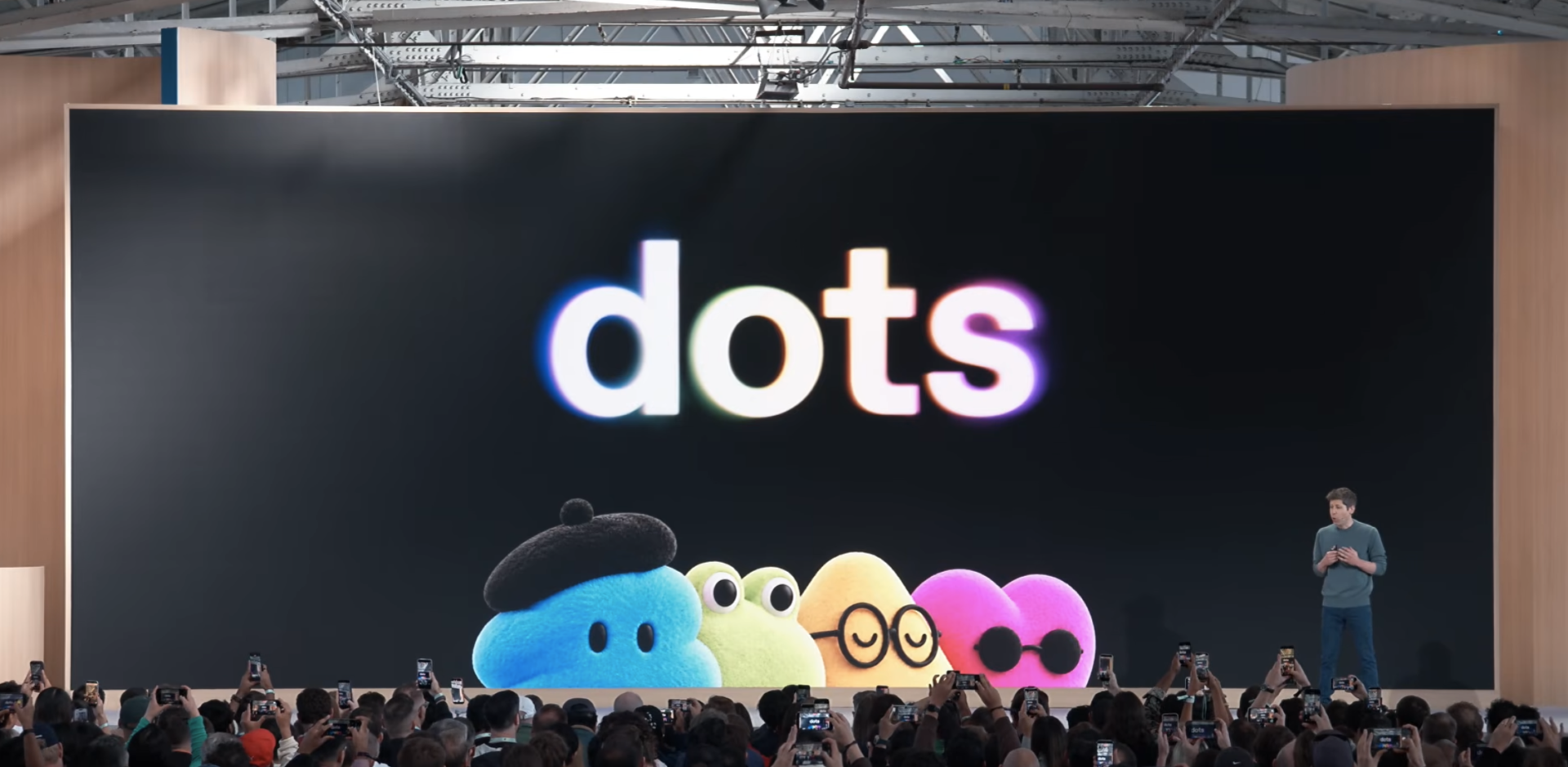
OpenAI just announced dots, and I think this could turn out to be a much bigger development than another incremental ChatGPT feature.
Dots are persistent, always-on AI agents that have their own cloud computer and browser and can continue working toward a user’s goals even when that person is not actively sitting in front of ChatGPT. In practical terms, this starts moving us away from the idea of AI as something we simply “chat with” and much closer to AI as something that actually works alongside us.
There are two things about this announcement that immediately stand out to me.
The first is the incredible rate of progress taking place right now across the frontier AI labs. We are no longer talking about new features being introduced every few months in the traditional software-development sense. We are watching the way we interact with AI fundamentally change over periods of weeks and months.
The second is what this means for the growing ecosystem of independent AI agent platforms such as OpenClaw and Hermes, which were built in large part to bridge the gap between a conversational interface like ChatGPT and an always-on intelligent agent that could access the internet, operate a computer, connect to applications, and take actions on your behalf.
I have been experimenting extensively with these kinds of systems over the past several months, and dots makes me wonder how much of that separate agent layer we will ultimately need.
The Speed of Progress Is Hard to Overstate
I have worked in technology for more than two decades, and I cannot remember another period when the capabilities of a major technology platform were changing this dramatically in such short periods of time.
This is not simply a faster software-release cycle. The underlying interaction model is changing.
Only a short time ago, most people thought of ChatGPT as a chatbot. You typed something into a box, it generated a response, and the interaction ended there. Since then, we have seen increasingly capable reasoning models, multimodal interfaces, browsing, coding, tool use, enterprise integrations, computer use, long-running tasks, and now persistent agents.
What makes this particularly striking to me is that I am seeing the progression firsthand in everyday use.
I have been using this technology heavily for the past several years across all kinds of workflows, including research, writing, coding, website maintenance, strategy, analysis, troubleshooting, and automation. One of the things I find most interesting is going back to something I attempted six months earlier and asking a newer model to do the same task.
The difference can be dramatic.
I have used AI to refresh old website code and content, troubleshoot problems, reason through decisions, build tools, and create new material. When I revisit those same kinds of tasks months later, the model often approaches the problem completely differently. The reasoning is stronger, the conclusions are better, the output requires less correction, and the system is capable of handling work that previously required much more guidance.
That is what makes the progress feel so real to me. It is not a benchmark chart or a research paper. I can see the difference directly in the quality of the work.
Why I Started Experimenting With OpenClaw and Hermes
Over the past several months, I have been sharing some of the experimentation I have been doing with OpenClaw and Hermes, using cloud LLMs from OpenAI, Anthropic, and Google to power different kinds of agents.
The attraction of these platforms was that they could do things that a traditional chat interface could not.
I could create agents that behaved more like persistent digital workers. I have experimented with using them as:
- a coder
- an executive assistant
- a brand manager
- a research assistant
- a digital tutor for my kids
I have also experimented with connecting them to messaging platforms such as Telegram, and I have been working on a similar setup through Discord.
The idea is compelling because instead of opening ChatGPT and starting another conversation, you can have an agent that is always available, has access to specific tools and instructions, and can perform work independently.
For a while, that represented a meaningful difference between an external agent platform and ChatGPT itself.
But something interesting has started happening in my own workflow.
I Have Already Started Moving Work Back Into ChatGPT
Even before the dots announcement, I had gradually started using my OpenClaw agents less for certain kinds of work and moving more of that activity back into ChatGPT.
One reason is that OpenAI has been steadily adding capabilities that previously required a separate agent platform.
Google Workspace integration is a good example. I created a dedicated Google account that I connected to ChatGPT, and I share documents into that environment from my primary account. That allows me to work with ChatGPT directly on documents, research, drafts, and other materials stored in Google Drive.
In practice, it increasingly feels like collaborating with an always-available member of staff.
OpenClaw was already capable of doing similar things, but as ChatGPT has added more integrations and tools, I have found myself asking a very practical question: why introduce another layer if the platform I already use every day can do the same work more easily?
There is also another advantage ChatGPT has that is much harder for a newer agent to replicate: history and context.
I was one of the early ChatGPT users, signing up within the first few days after it launched, and I have been using it heavily ever since. Over that time, ChatGPT has accumulated years of context around how I think, how I write, the kinds of work I do, my preferences, my strengths, and even some of my weaknesses.
That makes a huge difference.
If I ask ChatGPT to help me write about a topic, think through an idea, or challenge an assumption, I do not have to start from zero. It already understands a great deal about how I approach things.
My OpenClaw agents do not have that same depth of history.
I can export summaries, create markdown files, give them context documents, and keep feeding them more information, but it still is not quite the same.
The analogy I keep coming back to is the difference between asking for advice from a friend you have known since high school and asking someone you met at a networking event six months ago. Both people may be intelligent and capable, but one of them simply knows you better.
I think this idea of accumulated personal context is going to become one of the most important competitive advantages in AI over time.
This Is Where Dots Gets Really Interesting
Up until now, there were still some things that my external agents could do that felt fundamentally different from the ChatGPT experience.
They could remain active. They could operate in their own environment. They could continue performing work when I was not there. They could monitor systems, interact with applications, and behave more like persistent digital workers than conversational tools.
Dots goes directly after that gap.
That is what makes this announcement so important.
OpenAI is taking a model of computing that technically inclined users have been building themselves using tools like OpenClaw and Hermes and turning it into something that can potentially be used by a much broader audience.
If OpenAI can make that experience simple enough, the question changes from:
Can I build my own autonomous AI agent?
to:
Why would I build and maintain one separately if my primary AI platform already gives me one?
That does not mean platforms like OpenClaw or Hermes suddenly become irrelevant. They will still have advantages for people who want more control over the infrastructure, different underlying models, specialized integrations, custom orchestration, or the ability to operate in environments they completely own.
But the competitive line is clearly moving.
And it is moving fast.
Personal AI Context May Become More Important Than the Model Itself
There is another aspect of this evolution that I think gets less attention than it deserves.
For the past several years, much of the AI conversation has focused on model capability. Which model is smartest? Which one codes best? Which one scores highest on a benchmark? Which one has the largest context window?
Those things matter, but I think another factor will become increasingly important: how well the AI knows the person using it.
Imagine an AI assistant that has worked alongside you for ten or twenty years. It understands how you communicate, how you make decisions, what you value, what you struggle with, what you have tried before, and what has worked or failed in the past.
That kind of accumulated knowledge becomes incredibly powerful.
This is also where I think the future becomes particularly interesting for children growing up today.
A child born now could conceivably have a digital companion that grows alongside them for decades. It could remember their experiences, understand their learning style, know where they struggled in school, recognize patterns in their development, and help them navigate decisions over the course of their life.
Eventually, that intelligence may not live only on a screen. As humanoid robotics progresses, some of these systems will increasingly be embodied in physical machines.
That may sound extreme today, but the trajectory is becoming much easier to imagine than it was even a few years ago.
I Keep Thinking Back to a Conversation I Heard in 2015
All of this keeps bringing me back to an experience I had while working at Fast Retailing.
Each year, Fast Retailing held a major two-day company conference at Pacifico Yokohama in Japan. The auditorium holds roughly 5,000 people, and we would fill the hall with corporate staff and retail frontline employees from Japan and abroad.
Tadashi Yanai, the founder of Fast Retailing and UNIQLO, was close to Masayoshi Son, the founder of SoftBank. Yanai also served on SoftBank’s board.
At one of these conferences in 2015, Yanai invited Masa Son to participate in a fireside conversation.
I still remember the session very clearly.
Masa was standing in front of thousands of retail employees talking about artificial intelligence, robotics, and the technological singularity.
This was 2015.
We were not regularly using terms like AGI and ASI in everyday business conversations the way we are today. But the underlying ideas were already being discussed.
One thing in particular has stuck with me: Masa said he believed we could reach singularity around 2030.
At the time, that sounded incredibly far-fetched and almost science fiction.
Today, it feels very different.
Given the rate of progress we have seen just over the last several years, I find myself wondering whether his prediction may prove to be surprisingly close, even if our eventual definition of “singularity” turns out to be different from what people imagined in 2015.
We are now only a few years away from 2030.
When I think about where AI capabilities were in 2022 compared with where they are today, it becomes difficult to confidently say that something like this is decades away.
What Does “Singularity” Even Mean?
There are several definitions of the technological singularity, but the general idea is a point at which artificial intelligence becomes capable enough, and technological progress becomes rapid enough, that the future beyond that point becomes extremely difficult to predict.
Often, the concept also includes some form of recursive improvement, where AI systems begin contributing significantly to the development of better AI systems.
That does not necessarily mean that one morning an AI system suddenly becomes all-knowing and humanity wakes up in a science-fiction movie.
The transition may be much less obvious than that.
In fact, one of my personal beliefs is that we may cross important thresholds, like achieving AGI and ASI, long before we collectively agree or even think we have crossed them. Once the machines achieve that level of intelligence, do you think they will make it obvious that they have?
The debate about AGI is already showing signs of this problem. There is no single universally accepted definition, and different people will move the goalposts depending on what systems can already do.
We could very well reach some meaningful version of AGI and spend the following six months arguing about whether it “really counts.”
I do not know when AGI, ASI, or anything we would call the singularity will arrive. I am skeptical of anyone who claims to know the exact date.
But I also would not assume we are safely many years away.
The rate of improvement makes that assumption increasingly difficult to defend.
AI Is Already Helping Build the Next Generation of AI
One of the more interesting signals is what is happening inside the frontier AI labs themselves.
Anthropic has said that a very large share of the code going into its own systems is now being written with the help of Claude. That does not mean AI is autonomously rebuilding itself without human involvement, and it would be a mistake to overstate the significance.
But the direction is still notable.
AI systems are increasingly helping engineers write the code used to build and improve AI systems.
That begins to resemble at least one part of the recursive-improvement idea that people have associated with the singularity for decades.
And this is where the speed becomes so important.
If better AI helps people build better AI faster, and those improved systems then help build the next generation even faster, the development cycle itself begins to compress.
We may already be seeing the early stages of that feedback loop.
The Bigger Question Is Not Whether Dots Wins
Dots may become an enormous success, or it may simply be one more step toward whatever comes next.
To me, the important part is what it represents.
A capability that recently required technically sophisticated users to stitch together language models, computers, browsers, APIs, messaging platforms, integrations, permissions, and agent frameworks is rapidly becoming something that mainstream users may simply be able to turn on.
That pattern has repeated itself throughout the last several years of AI.
Capabilities that begin at the frontier quickly become product features.
Those product features become platforms.
And those platforms increasingly start performing work that previously required humans to operate software themselves.
For technology leaders, that creates a much bigger strategic question than simply asking, “How should we use generative AI?”
The emerging question is:
What happens when every employee, every function, and eventually every customer can have persistent intelligence working on their behalf?
That question touches almost every part of enterprise technology: operating models, cybersecurity, identity, governance, data, enterprise architecture, software development, talent, workforce planning, and the future of work itself.
I do not pretend to know exactly where this ends.
But I keep coming back to that conversation I heard from Masa Son in 2015.
At the time, 2030 sounded incredibly far away.
Today, watching the rate at which these systems are evolving, it suddenly does not feel very far away at all.